
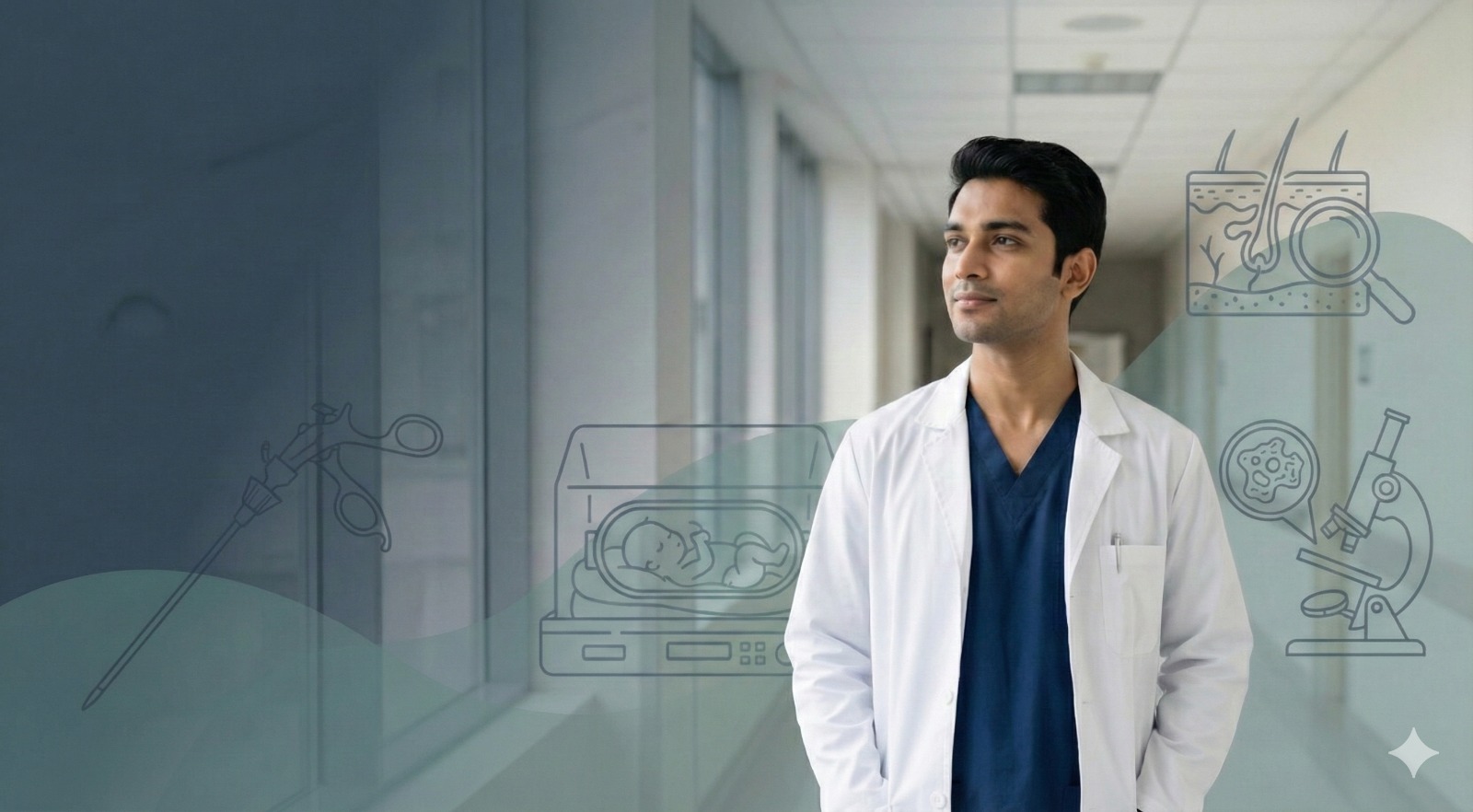
Healthcare in India is evolving at a pace few industries can match. Expanding patient volumes, rapidly advancing technology, and rising expectations around outcomes have fundamentally changed how medicine is practiced. For young doctors, this creates both opportunity and pressure. Completing MBBS or postgraduate training is no longer the finish line—it is the foundation on which continuous learning must be built.
Today’s clinicians are expected to adapt quickly, refine their skills regularly, and stay aligned with changing clinical realities. At the same time, most doctors cannot afford to step away from active practice for long periods. This has made flexible, structured upskilling an essential part of building a sustainable medical career.
This guide outlines some of the fastest-growing medical specialties in India and explains why focused, practice-oriented upskilling has become critical for young doctors navigating these fields.
Shifts in disease patterns, earlier diagnoses, technological integration, and patient awareness have all influenced which specialties are expanding rapidly. Fields that combine procedural expertise, multidisciplinary collaboration, and technology-driven care are seeing the strongest demand.
Upskilling in minimally invasive surgery and orthopaedic subspecialties now focuses heavily on hands-on exposure and case-based learning rather than theory alone. Doctors who invest in practical training are better prepared to translate learning directly into improved surgical outcomes once they return to routine clinical practice.
The demand for trained professionals in maternal and neonatal care continues to grow. Advances in perinatal medicine have improved survival rates for premature and high-risk newborns, but they also require doctors to manage increasingly complex clinical scenarios.
Neonatal intensive care and structured neonatology training equip doctors with skills that are valuable not only in large tertiary hospitals but also in smaller centres that manage high-risk deliveries. Flexible learning models allow clinicians to develop these competencies without long interruptions to their existing practice.
Dermatology has expanded beyond conventional clinical practice. Patient demand for aesthetic and procedural dermatology has increased significantly, and modern dermatologists are expected to balance medical dermatology with cosmetic treatments.
Doctors pursuing dermatology and cosmetology upskilling often seek programs that integrate evolving aesthetic medicine trends with strong clinical fundamentals. Continuous learning in this space allows practitioners to meet patient expectations while maintaining ethical and evidence-based care.
Diagnostics remain the backbone of effective clinical decision-making. As medicine becomes more personalized, the role of pathology and laboratory medicine has grown in both complexity and importance.
Advanced training in pathology and subspecialties such as dermatopathology enables doctors to contribute meaningfully to multidisciplinary care teams. Beyond traditional hospital roles, expertise in diagnostics also opens pathways in academic medicine, quality assessment, and specialised laboratory leadership.
Subspecialties within ENT, particularly laryngology, are seeing steady growth due to increased recognition of voice, airway, and swallowing disorders. Similarly, plastic and reconstructive surgery continues to expand as functional and reconstructive outcomes become central to patient care.
Doctors trained in these areas often combine surgical precision with long-term patient impact, making structured subspecialty training essential for those seeking depth and sustainability in their careers.
Cancer care and intensive care medicine remain among the most demanding yet impactful fields in healthcare. Advances in oncology have led to more complex treatment protocols, requiring clinicians who are comfortable working in multidisciplinary environments.
Critical care training prepares doctors to make high-stakes decisions in time-sensitive settings, where expertise directly influences survival and recovery. These specialties require not only strong clinical foundations but also continuous skill refinement to keep pace with evolving standards of care.
While no single specialty is right for everyone, areas such as minimally invasive surgery, neonatal care, dermatology, diagnostics, ENT subspecialties, plastic surgery, oncology, and critical care continue to show strong demand across the country.
What increasingly differentiates successful practitioners is not just the specialty they choose, but how consistently they update their skills. Access to structured, flexible learning plays a crucial role in turning theoretical knowledge into confident, real-world practice.
Platforms like Global Healthcare Academy support this shift by offering upskilling programs designed around the realities of clinical work. By enabling doctors to learn alongside their practice- rather than stepping away from it-such models help bridge the gap between education and application.
Choosing a medical specialty is an important milestone, but it is continuous learning that ultimately shapes a long and effective career. Doctors who stay adaptable, invest in practical skill development, and respond to changing patient needs tend to grow steadily over time.
With the right learning framework and institutional support, young doctors and practicing clinicians can strengthen their expertise without compromising patient care. In the long run, this approach benefits not only individual careers, but the healthcare system as a whole- ensuring better outcomes, stronger clinical confidence, and more resilient medical practice.
In a day, when you don't come across any problems - you can be sure that you are travelling in a wrong path.
- Swami Vivekananda© 2026 Global Healthcare Academy, All Rights Reserved.